
Bearing structure
Ball Bearing Cages
Plastic cages that keep balls separated and guide them within the bearing arrangement.
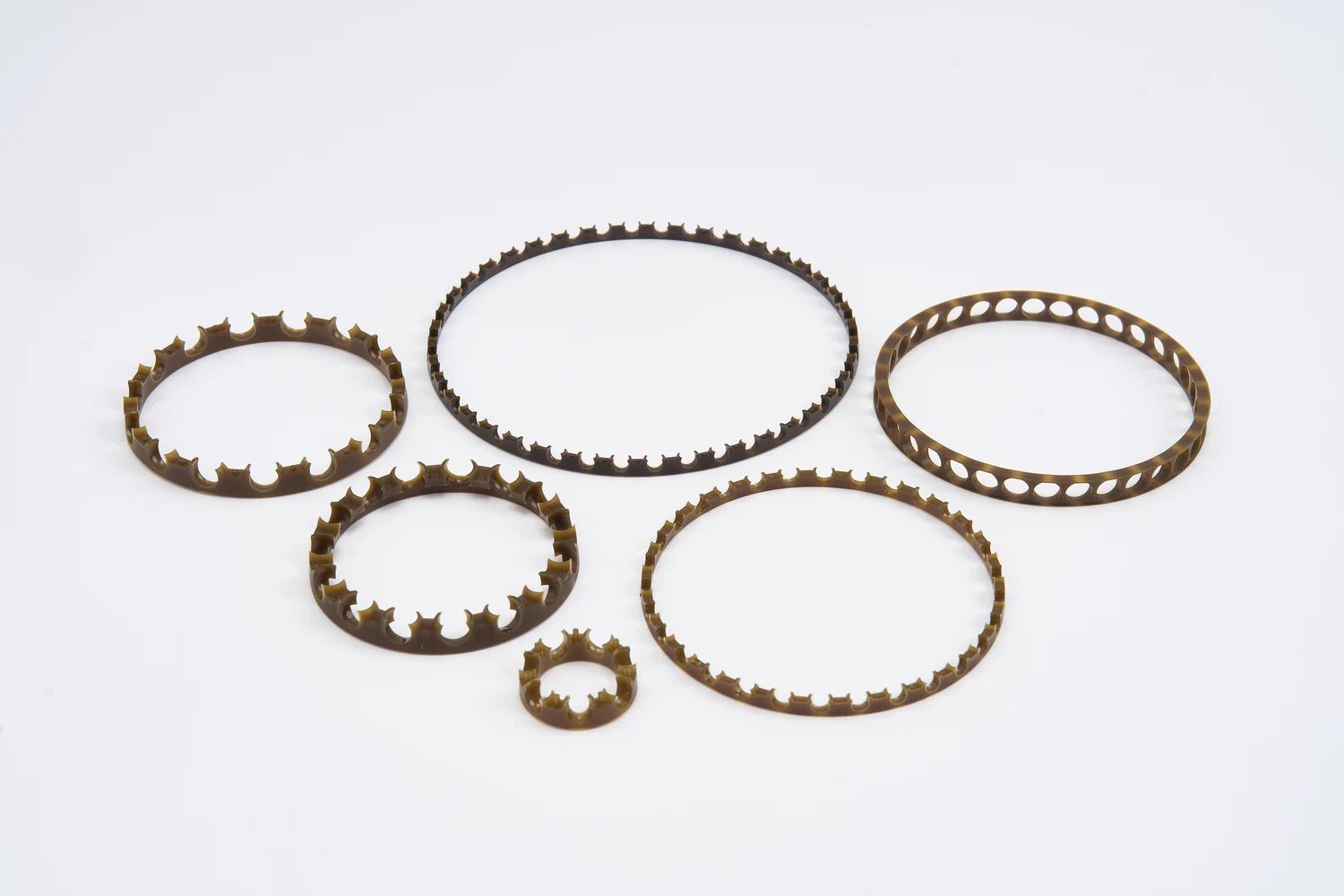
Application and design
The ball-bearing design determines the pocket geometry and cage assembly method. Share the intended bearing structure so the cage can be reviewed against the balls, raceways and available installation space.
Supply scope: Custom plastic cage components. Balls, bearing rings and complete ball bearings are not included.
Materials & customisation
Material selection balances pocket stability and assembly requirements with the operating environment. Specify an existing material grade or describe the conditions for a project review.
Choose from the nylon materials below for your cage design and operating conditions. The specific resin grade is agreed for the project.
| Material code | Material description |
|---|---|
| PA66 | Unreinforced polyamide 66 |
| PA66-GF10 | 10% glass-fibre-reinforced polyamide 66 |
| PA66-GF15 | 15% glass-fibre-reinforced polyamide 66 |
| PA66-GF25 | 25% glass-fibre-reinforced polyamide 66 |
| PA66-GF30 | 30% glass-fibre-reinforced polyamide 66 |
| PA46 | Unreinforced polyamide 46 |
| PA46-GF15 | 15% glass-fibre-reinforced polyamide 46 |
| PA46-GF25 | 25% glass-fibre-reinforced polyamide 46 |
| PA46-GF30 | 30% glass-fibre-reinforced polyamide 46 |
Typical raw-material property ranges
| Property | PA66 | PA46 |
|---|---|---|
| Densityg/cm³ | 1.13–1.36 | 1.18–1.41 |
| Tensile stress, dryMPa | 85–190 | 100–210 |
| Tensile modulus, dryGPa | 3.0–10.0 | 3.3–10.0 |
| Melting point, DSC°C | ≈260 | ≈295 |
| Heat deflection temperature°C · 1.8 MPa | 75–250 | 190–290 |
Ranges summarise the example resin grades below for initial material selection. Finished-part performance is reviewed for the selected grade and application. Tensile stress uses dry yield or break values. Continuous operating temperature is assessed separately for the grade and conditions.
Reference grades and manufacturer data
Design requirements
- Bearing structure
- Identify the bearing arrangement and the function of the cage within it.
- Balls and pockets
- Provide ball diameter and quantity, pitch-circle dimensions, pocket shape and cage envelope.
- Assembly and conditions
- Describe the assembly method, required clearances, speed, temperature and lubrication.
Custom development and project enquiries
Boerjing develops molds and manufactures precision injection-molded plastic parts from customer drawings or approved samples. We support mold trials, sample approval, small-batch validation and repeat production.
Start with the component and intended use. Share available drawings or samples, material requirements and expected quantities.